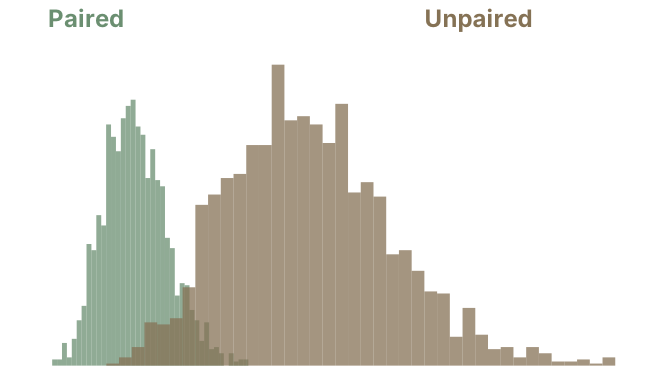
A hobby and research project exploring how imitation learning is best handled with a limited supervision budget.
I started Grounded Recovery after my master’s thesis to explore imitation learning and its use in robotics. I was particularly interested in a practical question: when expert labels are limited, which situations are most worth learning from?
Alongside the experiments, I built interactive visualizations and small lessons to work through the fundamentals myself. It’s something I enjoy, and often how abstract ideas start to make sense to me.
This website was created for curious minds engaging with imitation learning: a short, visual introduction to imitation learning and DAgger-style approaches. I hope it offers a useful starting point for others coming to the subject, too.
Two ways to spend the same labels
- Expert demonstrations cover a narrow band of states. A learner trained on them knows what to do inside it.
- Extra demonstrations spend a label budget inside that band, on the kind of states the learner has already seen.
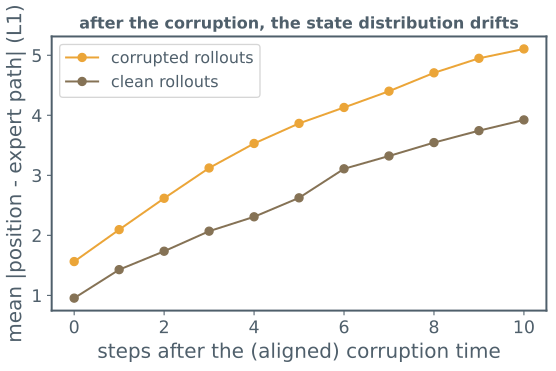
- Deployment: one wrong action can take the learner off the band, into states no demonstration covers. There, small errors compound.
- Corrections spend the same budget on the states the learner reaches after such a mistake, each labelled with the expert’s way back.
Which of the two helps more is what the study measures.
How are limited expert labels best spent on imitation learning for robots?
An agent can learn from expert demonstrations or from advice after a mistake. With the same number of labels, which helps more? This project compares both in a small simulated maze.
Study
Compare more expert demonstrations with advice after mistakes. Both agents get the same label budget and amount of training.
Read the studySeven Lessons
See what the agent observes, how it learns, and why mistakes can lead it away from its training examples.
Start with the worldChoose a starting point
Follow the lessons in order or choose a topic. Each uses a small experiment to explain one idea.
A maze and a partial view
02 Partial observabilityWhy history matters
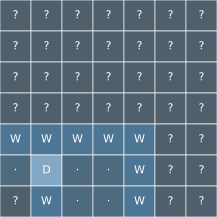 03 Expert labels
Learning from expert advice
04 Learning from examplesImitation and reinforcement learning
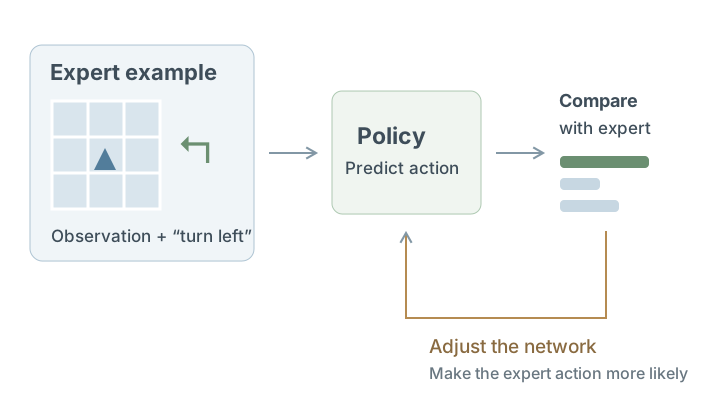 05 The network
From observations to actions
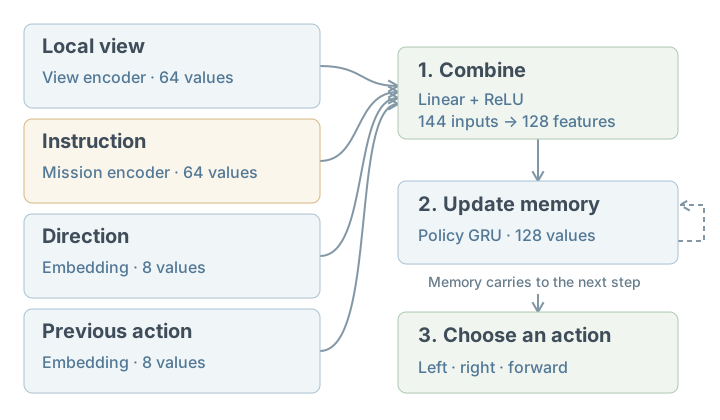 06 Errors and
recovery
06 Errors and
recovery
Where to collect new labels
 07 Measuring the
effect
07 Measuring the
effect
How to make a fair comparison