Chapter 01 of 08 · teaching experiments; the confirmatory evidence lives in chapter 08

The world: a maze, a mission, a window

Before anything can be learned, there must be a world to act in. Ours is deliberately austere, because every later claim about learning, failure, and recovery can be checked by looking at it directly.

My goal was to understand this topic deeply. Building the visualizations is what made the ideas concrete for me, and explaining each one in my own words pushed that understanding further still. That is why The Journey exists: it is the path I took, written out, one chapter at a time.

A fresh maze every time

The environment is from the BabyAI/MiniGrid family: each reset seed generates a new maze of connected rooms on a -cell grid, scatters a few colored objects, and issues a one-line instruction like “go to the grey box”. The episode succeeds when the agent stands next to the requested object facing it, and ends unsuccessfully after steps. Across generated worlds we counted distinct missions across six colors and three object kinds, one grammar.

A full episode, solved by the scripted expert of chapter 03. Every step of it already carries the kind of label this study spends its budget on.

What the agent actually sees

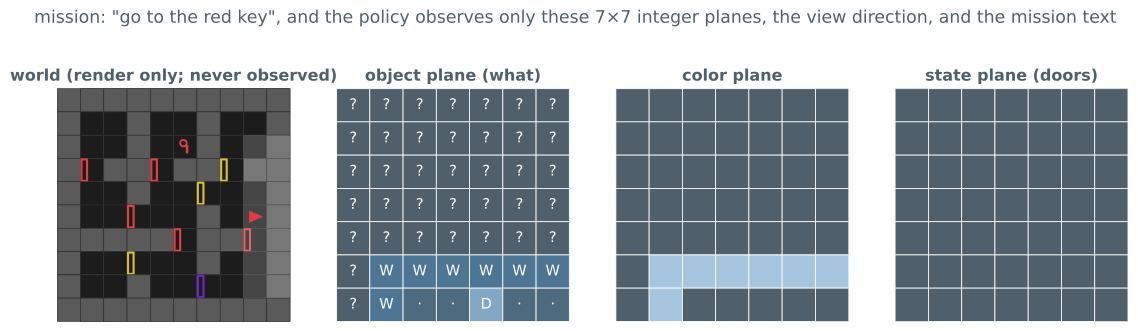
Not the maze. The observation is a symbolic 7×7×3 integer tensor: an egocentric, occlusion-aware crop of the cells in front of the agent, plus a view direction (0–3) and the mission string. The three channels are lookup indices (object kind, color, door state), not pixels; walls block sight, so much of a typical view is the “unseen” symbol.

Left: the rendered maze. Right: the three integer planes of one observation, with occluded cells marked as unseen.
One observation, dissected. The left panel is a rendering for humans; the policy receives only the three planes.

Step through it yourself

The scrubber below replays the expert episode from above, drawn directly from the symbolic data the models consume. The bright cone on the maze is the field of view; the right pane is the actual network input at that step.

What the agent can do

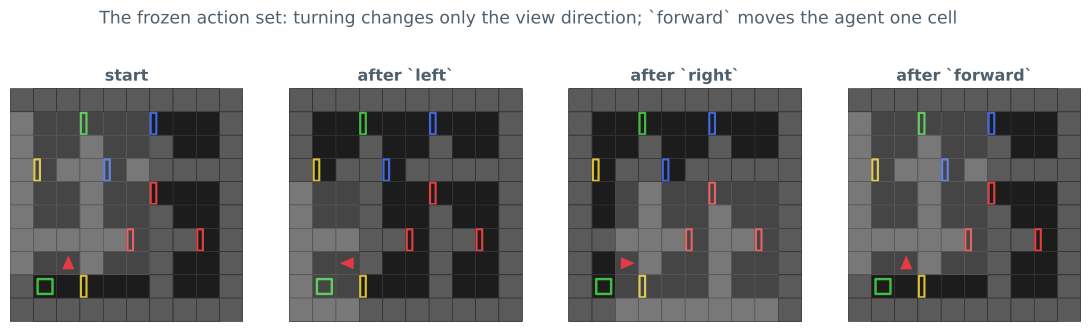
Three actions, , out of MiniGrid's seven. Turning rotates the view in place; forward advances one cell when nothing blocks it. Why the other four are excluded, and why this set must stay frozen, becomes clear when corruptions arrive in chapter 06.

Four panels: a start state, and the world after left, right, and forward.
The frozen action set, applied from one start state.

And a first taste of difficulty

The same world as the expert video, driven by uniformly random actions. Random wandering succeeds surprisingly often across many worlds (, measured honestly in chapter 03) but takes on average, against the expert's .

Summary

The world is a procedurally generated maze; the agent sees a 7×7 symbolic crop plus a mission string, and acts with three frozen movement actions. The gap between the world's state and that little window is the subject of the next chapter.