Examples & Live Code
Run real Blaze2D code live in your browser. No install required.
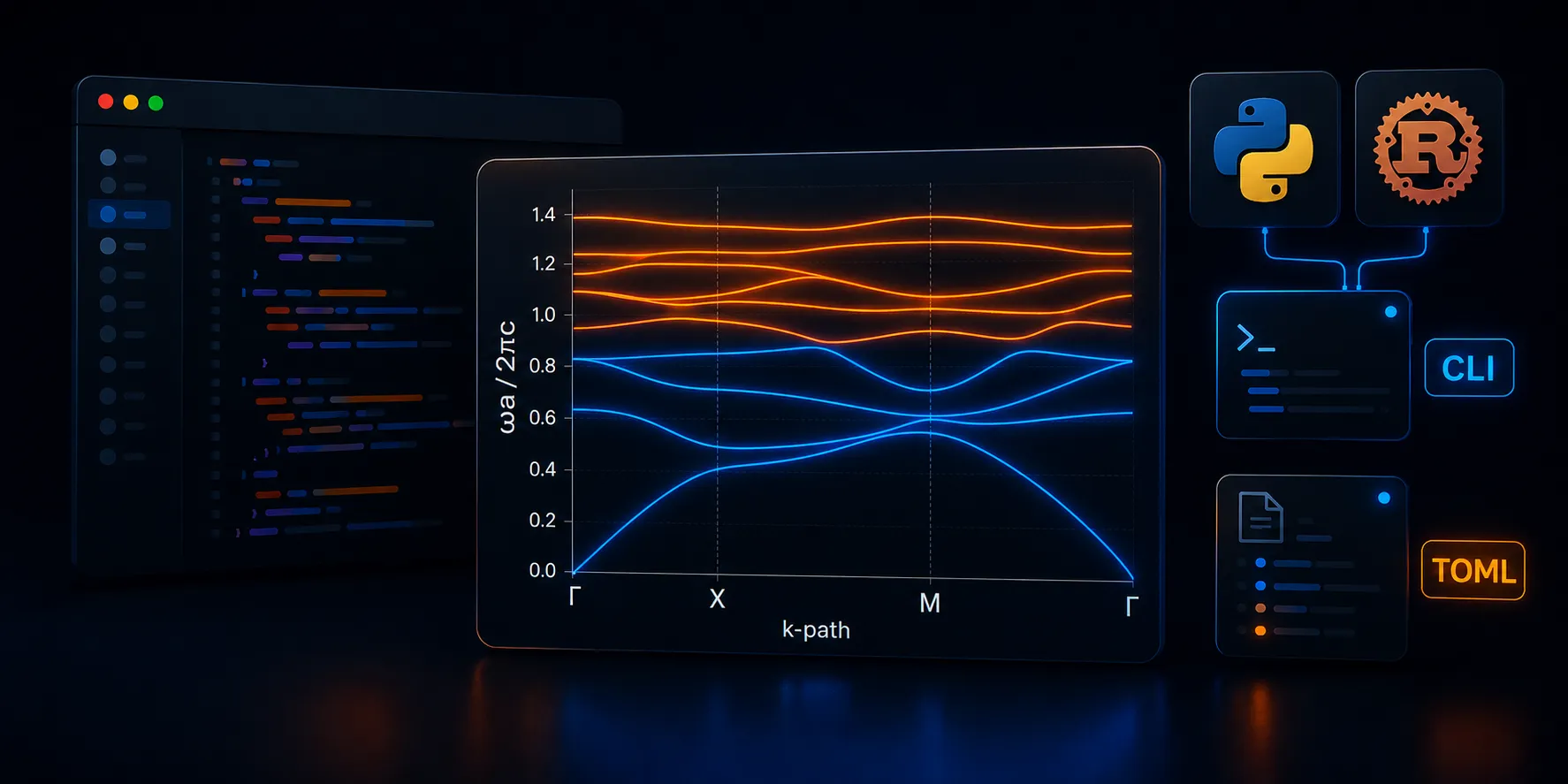
Blaze2D computes the photonic band structure of 2D crystals: you describe a
periodic arrangement of dielectric inclusions, and Blaze solves Maxwell’s
equations to find the allowed frequencies along a path through the Brillouin
zone. The engine is written in Rust for speed, but you’ll almost always drive
it from Python. The high-level blaze.solve() function is
designed to get you a band diagram in a handful of lines.
There are two ways to run Blaze, and the examples below use both:
| Interface | Best for |
|---|---|
blaze.solve(...) / CLI flags | Quick single runs, scripting, exploring parameters |
TOML configs via BulkDriver | Reproducible, shareable, version-controllable simulations and richer geometries (e.g. multi-atom bases) |
Every example on this page is fully runnable here in the browser. The exact
Python snippet you see is compiled to the same Rust engine via WebAssembly, so
the numbers you get match what pip install blaze2d produces on your machine.
Click any card to open a full-screen runner: press Run, watch the band
diagram fill in k-point by k-point, and inspect every field of the returned
object in a typed, expandable view.
A note on threads. The browser build is single-threaded (WebAssembly here runs on a single core). Examples that set a worker count still compute correctly, but the thread setting is ignored for live in-browser runs. On the desktop the same code distributes sweep jobs across all your cores.