Hard spheres are particles that do not attract each other and only collide. Packed densely enough, they still form crystals, driven by entropy alone. In a team project of three students, we simulated them with event-chain Monte Carlo: how they crystallize, and how they melt in two dimensions. My parts were a faster search for the next collision and sedimentation under gravity.
Event-chain Monte Carlo
Standard Monte Carlo proposes a small random move and rejects it if two spheres would overlap. In a dense packing, most moves are rejected. Event-chain Monte Carlo rejects no moves: a sphere moves in a straight line until it touches another sphere, and that sphere continues the remaining distance. One chain moves many spheres, and the method still samples the correct equilibrium.
Finding the next collision
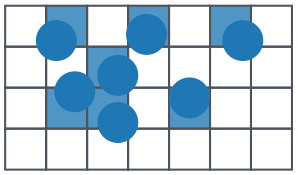
Each step of a chain needs the first sphere in the way. Checking all pairs of spheres costs time that grows with the square of their number. Instead, the box is divided into cells about one sphere wide, and each sphere is stored in the cell of its centre. A collision partner can only be in cells near the path.
Searching along the path
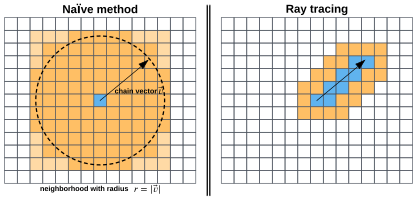
The simple search checks shells of cells around the moving sphere, so its cost grows with the searched volume. I adapted Bresenham’s line algorithm, a standard method from computer graphics, to the three-dimensional grid. This ray tracing visits only the cells the path crosses and checks their direct neighbors.
Cells checked per step
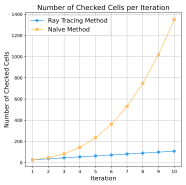
Counted from geometry, ray tracing adds nine cells per step in three dimensions. After ten steps, the shell search has checked nearly 1,400 cells, ray tracing just over 100.
This helps when moves are long, in dilute systems. In a dense packing, moves end within the first cells, and both searches cost about the same.
Gravity
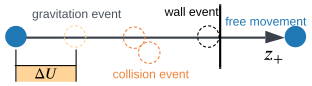
For sedimentation, the box got a fixed floor and ceiling. Gravity enters as an energy budget: for each upward move, a budget is drawn at random, and moving up uses it. When it runs out before a collision, a lifting event turns the move downward, as the ceiling does. No move is rejected, so the method stays rejection-free.
Sedimentation
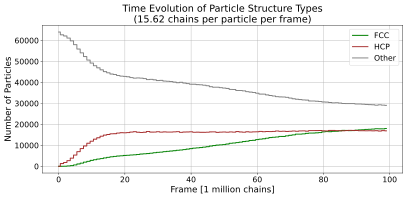
With 91,125 spheres, the bottom layers became a solid while the top stayed fluid. The transition between them spanned about three layers. A structure analysis classified each sphere by its neighbors: the solid was FCC and HCP crystal, with defects.
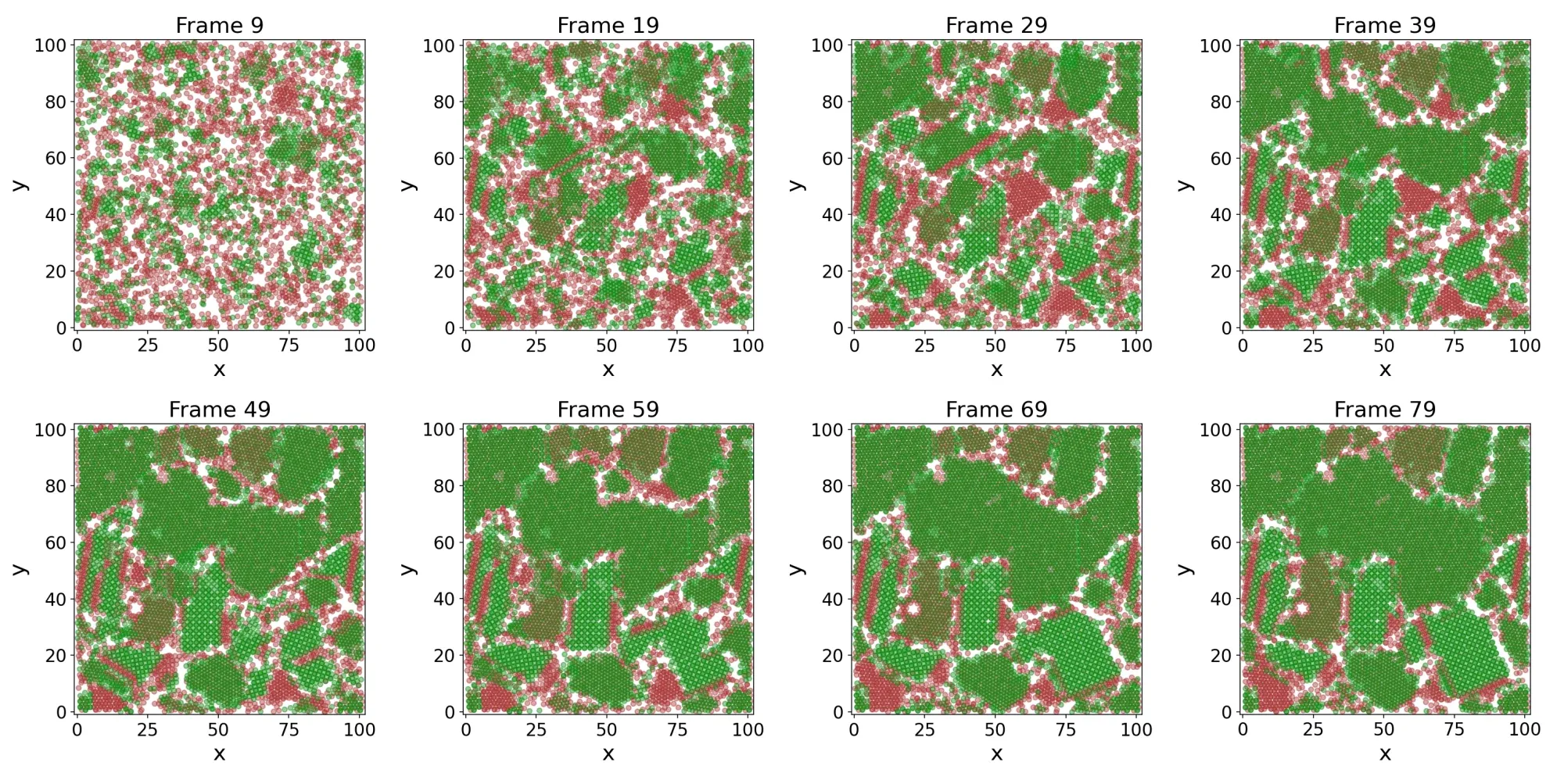
A view from below, in a second run with 64,000 spheres, shows small crystal patches that grow and merge into larger domains.
Validation against the equation of state
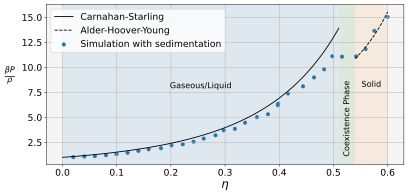
Before gravity was added, the code had to reproduce the known equation of state of hard spheres, the Carnahan–Starling equation. It matched in the fluid, showed a clear phase transition, and slightly overestimated the pressure in the solid.
With gravity, the weight of the spheres above sets the pressure at each height, so the pressure follows from the density profile. With one reference pressure chosen to match, it follows the equation reasonably well, slightly below it, and the phase transition is still visible.
Crystal growth over time
Spheres in HCP order appeared first and levelled off after about 20 frames. FCC grew almost linearly and passed HCP after about 90 frames. FCC was still growing when the run ended. Next steps would be longer runs, smoother density profiles, and other strengths of gravity.
Code
The simulation was written in C++ and later ported to Rust. The code was lost in a disk failure; the repository keeps the report and its figures. We exchanged code as files; one shared repository with feature branches would have kept it.
Context
Primary references
- Bernard, Krauth & Wilson (2009): Event-chain Monte Carlo algorithms for hard-sphere systems
- Michel, Kapfer & Krauth (2014): Generalized event-chain Monte Carlo: constructing rejection-free global-balance algorithms from infinitesimal steps
- Kampmann et al. (2021): Event-chain Monte-Carlo simulations of dense soft matter systems
- Verlet (1967): Computer “experiments” on classical fluids. I. Thermodynamical properties of Lennard-Jones molecules
- Bresenham (1965): Algorithm for computer control of a digital plotter
- Carnahan & Starling (1969): Equation of state for nonattracting rigid spheres
- Alder, Hoover & Young (1968): Studies in molecular dynamics. V. High-density equation of state and entropy for hard disks and spheres
- Piazza, Bellini & Degiorgio (1993): Equilibrium sedimentation profiles of screened charged colloids: a test of the hard-sphere equation of state
- Ackland & Jones (2006): Applications of local crystal structure measures in experiment and simulation
- Marechal, Hermes & Dijkstra (2011): Stacking in sediments of colloidal hard spheres
- Annuss, Nienhaus & Lehner (2024): Hard sphere simulations, final report
Novelty scope: Hard-sphere sedimentation, event-chain Monte Carlo, and grid-based neighbor searches are established methods. The contributions are implementations in a team project: a Bresenham-style walk through the cell grid for the collision search, compared by counting the cells it checks; and gravity and fixed walls added as lifting events, checked against the Carnahan–Starling equation of state. The crystallization and two-dimensional parts of the report are my colleagues’ work.